DCDC switching power supply has two common working modes, which are the PWM mode and PFM mode we often hear, one is the normal working mode, and the other is the low-power working mode. This section takes the BUCK structure switching power supply as an example to introduce The characteristics of the two work, and the method of distinction.
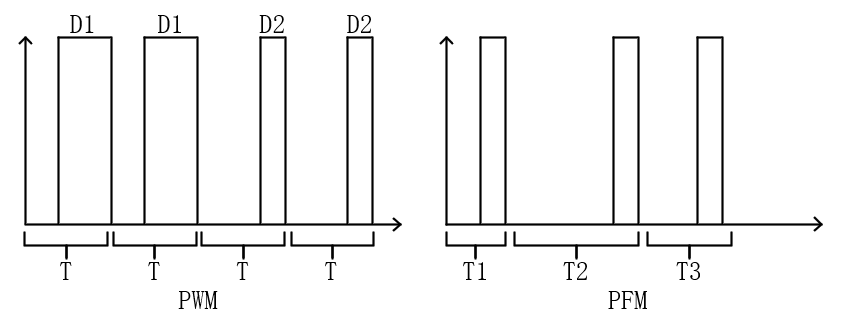
PWM: pulse width modulation, which is pulse width modulation, is characterized by a fixed switching frequency or a fixed switching period, and a variable duty cycle.
PFM: Pulse frequency modulation, which is pulse frequency modulation, is characterized in that the switching frequency is changed, or the switching period is changed.
The waveform comparison of the two is shown in the figure below.
Why use PFM mode?
This is because the load has different current consumption according to different working conditions, and the current varies greatly. The small current may only be a few mA, and the high current may be hundreds of mA or even several A. The efficiency is not high when the load current is low. In order to improve the efficiency of the power supply and reduce the switching loss of the power supply itself at low current, the PFM working mode is proposed.
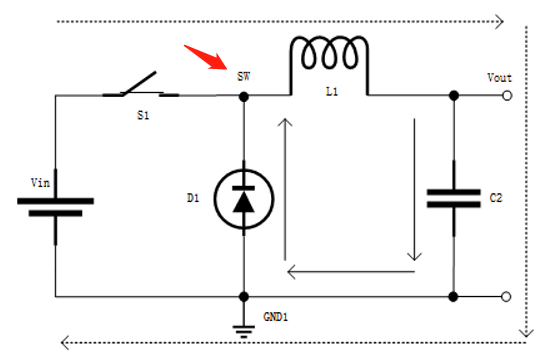
It can be known that in PWM mode, the BUCK tube is always on and off, and the inductor is continuously charged and discharged, while in PFM mode, the tube is only switched on and off occasionally, commonly known as intermittent switching, and occasionally charges and discharges the inductor once.
Since the control tube of the PWM mode BUCK is continuous switching, and the tube of the PFM mode is intermittent switching, this leads to the most significant difference between the two, that is, the ripple of the PFM mode is greater than that of the PWM.
How to judge whether the power supply is working in PFM or PWM mode?
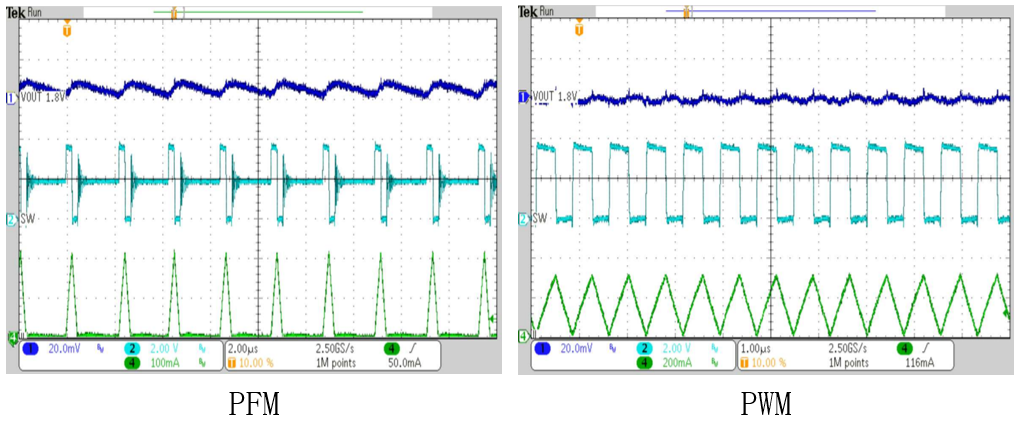
The figure below shows the PFM and PWM waveform test results of a certain power supply. The first row is the output voltage ripple. It can be seen that the ripple in the PFM mode is greater than that in the PWM mode. The second row is the voltage waveform at the position of the power switch node SW. You can see In the PFM mode, the switch stops when it is turned on, and the SW node in the PWM mode is always in the switching state, which can be used as a sign to distinguish between PFM and PWM.
The third row is the charge and discharge current waveform of the inductor. You can see that in the PFM mode, the inductor's intermittent charge and discharge waveform, while the PWM mode's inductor is continuously charged and discharged, which can also be used as a sign to distinguish between PFM and PWM modes.
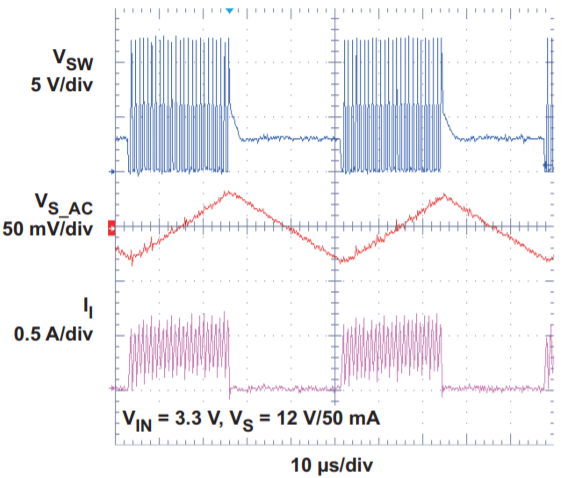
In the above waveform, the PFM mode is an intermittent switch once, and in some cases it is intermittently switched multiple times. For example, in the figure below, the first line is the waveform of the switch node, which is to generate the switching pulse sequence intermittently. It can be seen from the third line To the inductance, the inductance is repeatedly charged and discharged when the switch is switched, and the charge and discharge stop when the switch is stopped.