Wide bandgap (WBG) semiconductor devices such as silicon carbide (SiC) field-effect transistors (FEces are normally-off devices with user-friendly gate drivers. Their impressive "quality factor" combination outperforms competing technologies, with a particular focus on on-resistance per unit chip area (R DS xA), a measure of low static and dynamic power consumption combined with cost-effectiveness. Despite their smaller die size (meaning more cells per wafer and lower device capacitance), SiC FETs have exceeded expectations by demonstrating enhanced temperature resistance and higher peak current capability. Let's look at the numbers.
SiC FET On-Resistance Performance
Quantifying the performance of the SiC FET, as exemplified by t-wrap: wrap; background-color: rgb(255, 255, 255); box-sizing: inherit; vertical-align: inherit;" > xA value is 2.2 times better than that of a Gen 4 SiC MOSFET and remains constant over the entire temperature range. In fact, the device's on-resistance of 5.4 mΩ at 25 °C and 9.2 mΩ at 125 °C exceeds the V of silicon or SiC-MOSFETs rated at 600/650 and gallium nitride high electron mobility transistors (GaN HEMTs) in the same package by a factor of 4 to 10.
To achieve high current ratings with this ultra-low resistance, the example SiC FETs use silver-sintered die attach and advanced wafer thinning techniques to achieve a 0.1 °C/W thermal resistance from junction to case. In addition, the SiC devices have a maximum junction temperature of 175 °C, which means that a single device can handle 80 A continuously when connected to a simple 0.58 °C/W heatsink, with a junction temperature of 175 °C at an 85 °C ambient setting.
SiC FET Peak Current Ratings
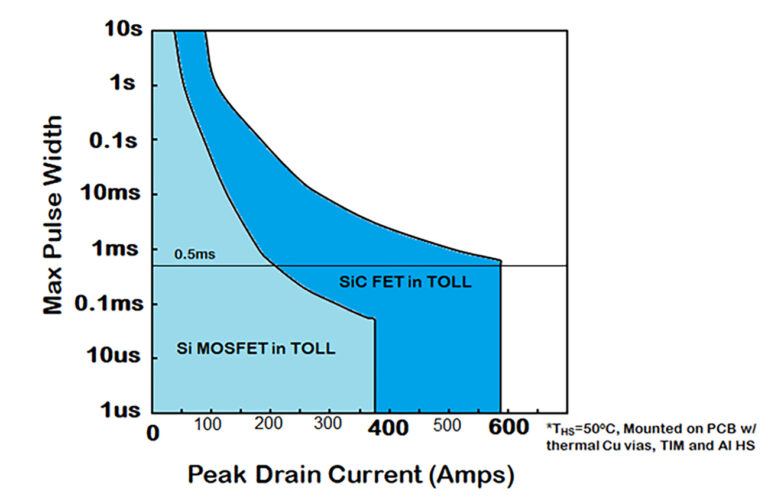
The maximum junction temperature ( T J,Max ) value of a SiC device and its current rating are essentially determined by the package used. Although SiC has an inherent material capability to operate safely at temperatures in excess of 500 °C, the JFETs for common-source, common-gate SiC FETs are limited to a maximum temperature of 175 °C. This limitation still allows the SiC FETs to handle transient peak currents that are significantly higher than their sequential ratings during startup at lower temperatures. Transient thermal impedance plots for specific chips and packages (such as the SiC FET devices mentioned earlier) summarize t dictate a transient thermal response of less than about 1 ms. With this arrangement, the continuous current rating is 89 A, as shown in Figure 3, and the device can handle peak currents of up to 588 A in a single pulse for 500 µs before reaching T J,Max at 175 °C.
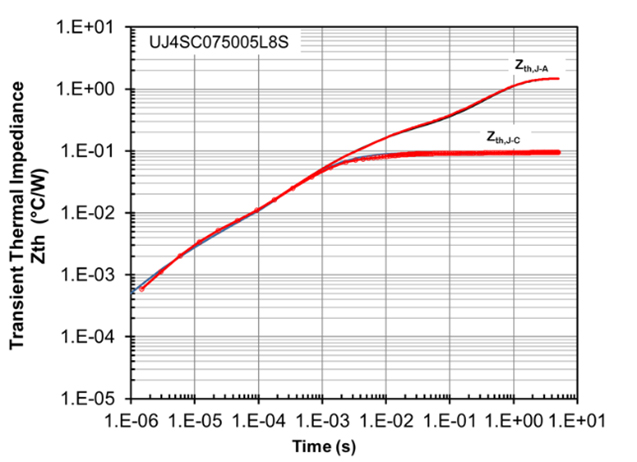
Figure 2: Modeled transient thermal impedance of the SiC FET device in a TOLL package when assembled on PCB with thermal vias, TIM, and Al heatsink.
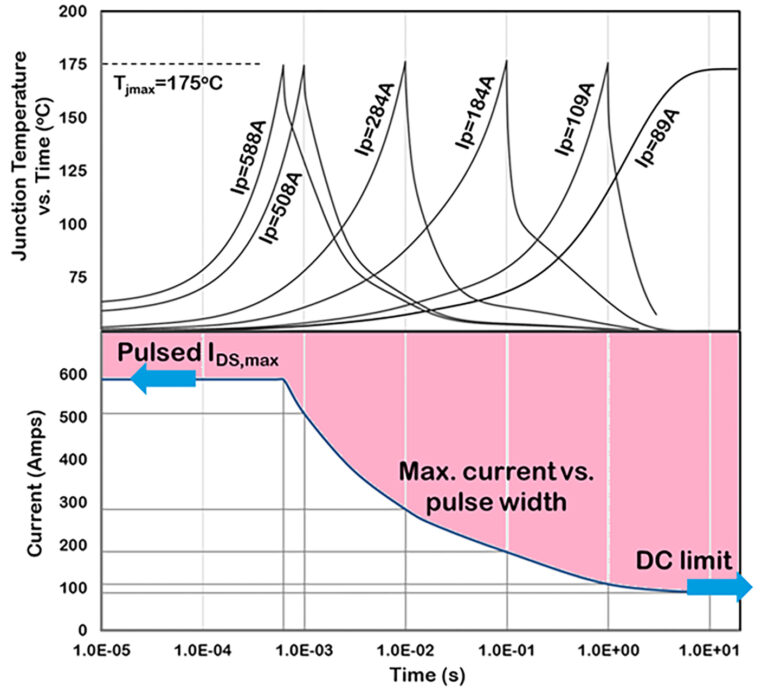
I 2 t" is a factor of 8.6, as shown in Figure 4.